

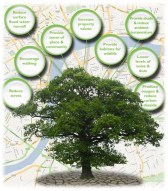
Conserving land through the creation of city parks system and green open spaces is a wise investment that produces both economic and natural benefits. It is about more than just aesthetics; it is a strategy for improving the public well-being and the economic viability of a city. Parks and recreation facilities help build a community’s socioeconomic status by bringing people together and encouraging safer, cleaner neighborhoods. They improve physical and psychological health, strengthen communities, and make cities and neighborhoods more attractive places to live and work (Sherer, 2006). They also provide substantial environmental benefits by helping to reduce air and water pollution, by keeping cities cooler, and by providing a more effective and less expensive way to manage storm water runoff than building systems of concrete sewers and drainage ditches (Sherer, 2006).
What are the Economic benefits of Parks?
The science of the economics of open spaces and parks is still in its infancy but several studies have been conducted to analyze the values of certain measureable aspects of open spaces and park systems. For example, property value, tourism, direct use, health, community cohesion, clean water, and clean air—have been enumerated in several studies conducted throughout the United States (Harnik & Welle, 2009). Some of these factors (e.g. increase property value, attracting business investments and tourism) provide direct income to a city’s treasury and others provide direct saving benefits for city residents while other indirect benefits are derived from some.
What are the Social Benefits of Parks?
City parks play a major role as a community development tools and offer recreation opportunities that can have positive impacts on the society. They make surrounding neighborhoods more livable and enable residents experience a sense of community; they offer recreational opportunities for low-income families, help to keep at risks youth off the streets by offering them a recreational environment where they can interact with their peers instead of engaging in negative acts. The latter particular helps in crime reduction and decreases juvenile delinquency. Most of the social impacts mentioned above have not been well documented. There is still a need for more research to back the many professional theories and speculation in support of these benefits. Nevertheless, the social impacts of parks on stewardship promotion and crime reduction are well studied (State of California Resources Agency Program, 2005). Open space, park and recreation areas are an ideal medium for encouraging and developing stronger stewardship of the land and the environment as people who enjoy outdoor recreation become more familiar with natural resources and the environment which helps them understand how their personal actions can affect the environment; this optimal experience can result in a state of connectiveness with the earth and its creatures, which in turn, can result in a greater sense of appreciation for the environment and the community of life
What are the Environmental benefits of Parks and Open Spaces?
Parks play a vital role in preserving and supporting healthy environments and provide substantial environmental benefits. Acquiring land for parks and open space helps assure the long-term preservation of environmentally significant land, helps to reduce carbon emission, improves water and air quality, mitigate climate change, control erosion, reduces congestion, enhances air quality, etc. Carbon emission in cities and urban areas (through transport, heating, etc.) pose a major threat to environmental sustainability. The creation of parks and more green open spaces in these areas is another effective strategy for limiting a city’s carbon footprint. These green spaces can contribute to reducing the atmospheric concentration of CO2 by:
– directly sequestering CO2 as woody and foliar biomass as they grow; soils equally have the potential to sequester carbon
– reducing the demand for heating and air conditioning, and reducing emissions associated with electric power production when trees are near buildings
Green space in urban areas provides substantial environmental and ecological benefits. They help to reduce air pollution and water pollution, they help keep cities cooler, and they are a more effective and less expensive way to manage storm water runoff, control erosion, and reduce carbon emission. They provide benefit for increase species habitat, increased species movement and increased protected species population; and this is particularly important for biodiversity. Most significantly, the derived benefits of parks and open spaces on a particular sector ultimately enhance the benefit of the other and the manner in which combined benefits may be gained is almost endless.


Leave a comment