
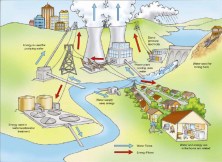
Water and energy are mutually dependent. Energy is utilized in providing fresh water while water is also an essential component in energy production. For example, every type of energy generation requires water to either process raw materials, maintain the plant or to generate the electricity. Similarly, when the needs for energy increases its water usage also increase. Having knowledge of the critical linkages between water and energy—and the impact of both on the environment, the need to understand the importance of water and energy to our health, economic growth and life quality in respect of their interdependence and issues with new energy resources is significant as the demand for these resource is on the increase. Both of these processes face growing limits and problems.
Is climate change having impact on water and energy?
In addition to the increase demand of population growth on water availability and usage, human-induced climate change is understood to be a key driver for change in energy and water availability, distribution, production and utilization. This carries significant implications for managing water and energy security challenges. Climate change impacts will likely exacerbate water stress in many countries, cities and communities, creating the prospect of greater competition between different uses, as well as individual users of water (WEC, 2009).
Current Efforts in Addressing Water and Energy Problems
Currently many efforts are been applied to address water and energy issues globally. For example, the Thirsty Energy Initiative at the 7th Annual World Future Energy Summit (WFES) was launched by the World Bank to identify synergies between water and energy resource management. This Initiative involves quantifying trade-offs and promoting energy dialogue and devising solutions depending on available resources among countries. Specifically, this initiative document will aid to mitigate the risks of the challenge and to help countries prepare for an uncertain future and to evaluate and discuss the risks to the energy sector, the shortages that are harmful to energy production as well as energy and water interdependence. Several other United Nations initiatives have been started to help address the issue of water and energy. For example, the Decade of Sustainable Energy for All (2014-2024) was launched by the United Nations which highlights the importance of improving energy, improving the shares of renewable energies and cleaner and efficient energy technologies with enhancing of the energy model to reduce water stress.
Are there any possible Solutions for the Management of Water and Energy?
Water and energy are both complicated issues with many variables impacting their management: population growth, agriculture, climate change, etc. Thus, resource managers and stakeholders must adopt comprehensive and interdisciplinary approaches that will consider various components of integrated energy-water planning that should be addressed both systemically and over long planning scope. Currently, the majority of integrated energy-water planning efforts are specific to the United States and many of the programs are in pilot and research stages (IEA, 2012).
Notwithstanding, the following key issues must be taken into consideration in order to improve management of the water-energy nexus:
1. Collaboration between government agencies and other stake holders such as academic institutions, environmental groups, industries, etc.
2. Develop appropriate technologies and approaches that correspond with the level of economic, social, and human resource development of a particular locality.
3. Developing countries have limited literature on energy projections and associated water consumption. Thus, it is important to provide comprehensive data on water and energy nexus through research.
4. Projecting for the uncertain future of energy and water that is expected to be created by exacerbation from population growth, climate change, agriculture, etc.
These major planning aspects relate to technical, policy, and socioeconomic factors. Interestingly, there are political barriers that affect energy-water planning because they are profitable natural resources. Thus, entrenched political and economic interests may prefer that resources and data sharing remain separate (IEA, 2012). In an effort to quantify the challenges facing the nexus, the IEA World Energy Outlook included a section on the possible future water constraints in the energy sector for the first time in its 19-year history.


Leave a comment